Wednesday, March 7, 2018

Exploring Hydroponics with Design Thinking

Our 7th graders recently completed a three-week Engineering Design Intersession (EDI).  Students interviewed school staff and peers to identify design challenges around campus and then chose which problem they could work in teams to solve. This Intersession took place in the BCS FabLab, so students had access to a variety of technology including 3D printers, laser cutters, design programs (i.e. TinkerCad) as well as power and hand tools.

BCS MakerSpace teacher Mick Coleman wanted to develop a hydroponics system that would allow him to grow plants in a space-efficient manner in his classroom.  Our 7th grade guest bloggers, Andy, Caleb, Naomi, and Noah, describe how they approached this challenge:

Please define the problem you were given and your proposed solution.

(Naomi) Our given prompt for our EDI 'Future Farm' project was that Mr. Coleman needs a hydroponics table, that water can flow through, for the MakerSpace on the BCS South campus. Using the Engineering Design Process, we first interviewed Mr. Coleman to gain his perspective and needs in order for our group to make a solution that would fit to his necessities. Mr. Coleman wanted to have a vertical table that he could hang lights on and one that he won't have to bend down, so our group created a prototype that suited what he wanted. Our solution was to create a taller vertical table with a frame and a top so lights could hang from them by a clip.


Can you describe the Ideating and Prototyping process?

(Caleb) The Ideating and Prototyping process took up a lot of our EDI time. We changed our design multiple times to fit Mr. Coleman’s requirements. This step in our EDI project made us more empathetic to Mr. Coleman’s desires for the hydroponics system. This was also the step where we encountered one of our major difficulties: cooperating. One of my teammates was very uncooperative because he/she disagreed with basically everything the rest of our group wanted. Eventually, this worked out, but the other three members in our group had to do most of the planning by themselves. I think the prototyping process was very useful in getting our ideas out; however, I would have liked more time to make a more detailed rapid prototype.

What did you learn during the testing phase?  How did that impact your final design?

(Noah) During the Testing phase of the project, we tried out our different ideas in the form of a physical model (prototype) as well as a SketchUp model. Afterwards, we would troubleshoot and redesign based on what we found out. Changes we made as a result included:

  1. We had to change the design from being a layered cabinet to being completely PVC
  2. We changed the PVC design to a wooden one in the shape of the PVC to be more aesthetically pleasing
  3. We gutted out all of the wood to make a frame because it would be easier to build and cheaper on the budget
  4. We had to put planks underneath our table to keep it from sagging
  5. We changed our one-sided table idea to a two-sided table idea

All of these changes led to the final design of the 'Hydro Grow'.


What were the challenges you faced in your group and as a group?  How did you resolve them?

(Andy) During Intersession, one of the challenges we faced, especially in the beginning, was working together effectively. We resolved this challenge by figuring out our individual skills and created roles for everybody based on their individual skills.

What do you think was the most valuable thing you learned during the Engineering Design Intersession?

(Andy) I think the most valuable thing I learned in EDI was how to cooperate. One of the many challenges our group had, and certainly one of the biggest, was to work well together. After over five hours together every day during the first week of EDI, it was hard to cooperate.

(Naomi) I feel like the most valuable thing I learned during EDI was that ideating was a very important step in our group's process. When we met a problem, such as how we couldn’t get our project through the door, we would iterate on our design until we solved the issues.

The "HydroGrow" team presents about their design to visitors

The Hydroponics Team project is a wonderful example of how students at BCS are honing their 21st century skills: working through problems, using the design thinking process to collaborate, iterate, prototype, and evaluate in order to develop creative and innovative solutions.

Friday, January 12, 2018

Bullis Charter School Students Engage in Global Climate Change Work

Bullis Charter School 6th – 8th grade students have been collaborating virtually with students in nineteen countries including Slovenia, Philippines, Peru, Kenya, Germany, New Zealand, Indonesia, Morocco, Sweden and Ghana to prepare the largest synthesis of youth research on colonization and climate change.  The culmination of this work resulted in two BCS students traveling to Bonn, Germany, to develop a white paper proposing actionable steps and policy initiatives to combat climate change on a global scale, which was then presented at the general assembly at the United Nations’ Climate Change Conference (COP23).  BCS was the only school in attendance representing the continental U.S.

Developing Global Citizens is a core tenet of the Bullis Charter School mission, so BCS Founding Superintendent Wanny Hersey welcomed the opportunity to partner with the Canada-based Centre for Global Education’s #Decarbonize:Decolonize initiative, which engages students around the globe to understand and take action on authentic and meaningful challenges facing the world today.  Hersey launched a #Decarbonize:Decolonize Club at BCS and invited all interested 6th – 8th graders students to join. Thirty three students began meeting over the summer to research many aspects of climate change, including ecological footprints, policy initiatives, changes in weather, deforestation, and the impact of climate change on indigenous people.  According to Hersey, “The integration of the UN Sustainable Goals in BCS’ Project Based Learning units has taught our students to develop empathy, work collaboratively, and solve problems on a global scale.”  The BCS group collaborated with students across the globe in Virtual Town Hall meetings to exchange ideas, debate alternatives, and ultimately create a document that represents their collective voice. BCS also partnered with a school in Peru to explore similarities and differences in each country’s approach to climate change.

Clarissa & Anushka arriving in Bonn for COY13
BCS 8th graders Clarissa Chen and Anushka Srinivasan traveled to Bonn to attend the Conference of Youth (COY13) and represent BCS at COP23. Chen, Srinivasan, and student representatives from 19 other countries worked together to synthesize the #Decarbonize:Decolonize research and draft a youth white paper, which was presented to the COP23 general assembly.  The themes that emerged in the paper were gold mining, hydraulic fracking, and water contamination, but also how young people can address these challenges now.  According to Srinivasan, “We tried to really show how youth could have an impact and our voices were important. We also tried to inspire other children around the world to get involved and make a difference.”  Student artists from all seventeen countries submitted art expressions reflecting their thoughts on climate change for a Global Gallery. The writing team included some of this art in the white paper as a way to express climate change themes without words, making it accessible across many languages. Four pieces of BCS student art were accepted into the Global Gallery. While in Bonn, Chen and Srinivasan also participated in a youth climate change march and met with staff from the Oregon governor’s office to discuss how youth can get involved at a local level.  After seeing their work culminate in an international presentation on climate change, the BCS #Decarbonize/Decolonize club students are energized to continue their work, share their passion and engage others to have their voices heard.
The team amongst artwork representing 17 countries expressions reflecting thoughts on climate change selected for the Global Gallery 
Clarissa, Anushka, and Superintendent Hersey participating in a youth climate change march
Q&A with Anushka & Clarissa

Why did you choose to get involved in the #Decarbonize/Decolonize club?

A: Just sixteen months after my trip to Chennai, India in July 2014, the area was hit by devastating rain and floods that claimed the lives of over five hundred people and permanently affected millions more. As I watched images of the floods on the news and the endless lines of people seeking shelter, I saw places that I had recently visited submerged by the flood waters. Scientists said that climate change was one of the possible causes of the storm, and that floodwaters were compounded by unrestrained construction. Before visiting Chennai, I did not know much about climate change, but after my visit, it became personal. When BCS joined #Decarbonize, I jumped at the opportunity to participate.

C: Before I joined the #Decarbonize:Decolonize initiative, I wasn’t really aware about global warming and its effect on the environment. I decided to join the club out of curiosity to learn more and I thought it would be a cool way to positively impact the world. This project also seemed like a unique opportunity to collaborate and learn from students all over the globe.

What did you learn from your research?

A: From my research, I learned how each part of the world was affected by climate change. My team (including the representatives from Indonesia, Australia, and Canada) did case studies on effects of climate change around the world. We studied the Dakota Access Pipeline controversy in the USA, the Sidoarjo mudflow in Indonesia, gold mining in Costa Rica and Peru, and the Bakken oil fields in Canada. Comparing and contrasting these different activities and events was very interesting and unique. I especially valued hearing from people who were directly affected by each of these situations.

C: Through our research, I learned how the issues within different countries are actually quite similar. Multiple countries face issues regarding water pollution due to mining and/or fracking. This made me realize how important it is for us to decolonize and unite to solve this issue. We are all impacted by the effects of climate change and the solution would benefit us all. If we all come together and make small changes in our daily lives, we can make a big impact. Something as small as eliminating single-use plastic straws, by drinking out of the side of the cup, can make a big change. In the US, over 500 million straws are used per day and each one can take 200 years to decompose if it ever decomposes. It was very interesting to compare our blog posts, through the virtual classroom, with other countries’ responses. An average American can create up to 20 metric tons of carbon waste in a year, while a Kenyan citizen will make less than one ton.

Can you describe your experience in Bonn?

A: My experience in Bonn was enlightening and exciting. Representatives from 19 different countries came to Bonn, and getting to interact with and learn from the other representatives was such a cool opportunity. While there, we wrote a white paper that summarized our work and stories. This white paper was shared at the 23rd annual Conference of the Parties and received international media attention. At the 13th annual Conference of the Youth, I met many people who were also studying the natural disasters brought on by climate change. While I had been moved to get involved because of the Chennai floods, others had been affected by the recent hurricanes in the United States or the droughts in Africa.

C: In preparation, before the trip, we had multiple video conferences with the different countries. Our middle school club of 30+ students met all the other schools within the initiative through one of our conferences. When we met for the first time in Cologne, we already recognized each other. Only a couple days before, we had been miles apart, communicating virtually, and then we were standing right next to each other. On the first day, we began with games and introductions. We also quickly began our work with our slide deck for our presentation at Conference of Youth (COY13). We spent the next few days at COY13, where we presented, attended sessions, and ate warm, vegan snacks and lunches. During the following days, we created the white paper, prepared for presentations, bonded over a theater workshop, and held some live webcasts. On our last day, we presented at a UNESCO school and a couple other friends presented at Conference of the Parties (COP23). Afterwards we celebrated our achievements with an afternoon off. We enjoyed sightseeing, delicious food, and relaxation. Later that evening, we reconvened and received special printed copies of our white paper. We signed each other's copies and shared one last night together. They even surprised me with a birthday celebration, as it was my birthday, which was pretty special. After many goodbyes, we parted our own ways, but continue to stay in touch and treasure our memories together.

What was it like to work with students from so many different countries?

A: Working with students from all over the world was an incredible experience. Everyone had different ideas and perspectives, so we were able to address a diverse and large audience. In addition, the community of students that came to Bonn was so supportive and kind. I am so grateful for the opportunity to work with them.

C: Working with the other students was an amazing experience. Within a couple hours, we became second family and really bonded together as a team. We were able to learn from each other and shared about our own experiences in our countries. Learning from so many different perspectives face-to-face was really unique. We had meals together and enjoyed comparing our countries’ common sayings, fast food restaurants, and currencies.

The team of students and teachers pose for a photo
on their way to the COP23 Conference.

What emerged as the themes of the students' collaborative work?

A: When the student representatives came to Bonn, we had very different, unique ideas for themes of our white paper. Over the ten days we were there, we combined these ideas and narrowed down themes to focus on youth. We tried to really show how youth could have an impact and our voices were important. We also tried to inspire other children around the world to get involved and make a difference.

C: Gold mining and hydraulic fracking emerged as themes between countries. We learned that these two issues occur in multiple countries, which made us realize that this is a big problem that we are all facing. Both of these events cause water contamination, which affects the local communities negatively. As our initiative is also about decolonization, we tried to focus on the indigenous communities and the impact global warming has had on them. Several times, indigenous communities are ignored by government leaders. For example, in the United States, the government wanted to install the Dakota Access Pipeline, but the Standing Rock Sioux tribe did not support the installation of the pipeline. The pipeline would destroy their ancient burial grounds and would risk contaminating the region’s clean water. Even though, one of the Sioux elders started a protest camp and people around the world came to camp alongside the native americans, showing their support, government officials still ignored their voice and installed the pipe anyway. Other student representatives shared that they also had struggles with water shortages and the indigenous communities in their countries have also been ignored.

Did you receive any feedback from adults after your presentation?

A: After my presentation at the 13th annual Conference of the Youth, we had some time to speak with audience members. The audience was composed entirely of adults, and we received lots of feedback about our presentation from them. They were all very impressed with our work and interested in learning more. They had only learned of climate change as adults, so they said that they felt very inspired and pushed to work harder because of our work.

C: After our presentations, both adults and other students, were really supportive of our initiative and were really interested in our work. At the German school, the students had a chance to ask the group questions and then we talked with the students individually. After realizing what a huge impact global warming has on the climate, the students were intrigued to learn more. Together we enjoyed conversation, made some new friendships, and exchanged contacts. The adults who were part of the initiative were supportive of not only their own students, but other countries’ as well. They provided feedback on how to improve our presentations and made sure that we didn’t get separated.

Can you describe your meeting with the Oregon Governor's representative? What did you discuss?

A: While in Bonn, I had the lucky opportunity to meet with Governor Kate Brown of Oregon’s representatives, Ruchi and Chris. I discussed what we were doing and how we got involved. Then, Ruchi explained how she had a law degree, and she gave up her career in law to work in climate change issues and conservation efforts. Her story was so inspiring to me and I am so grateful for her willingness to answer all of our questions and share her own story.

C: We had the opportunity to meet with two of Oregon Governor Kate Brown’s representatives, Ruchi Sadhir, Energy and Climate Change Policy Advisor, and Chris Pair, Director of Communications. Together we each shared about the actions we have been taking towards preventing climate change. My biggest takeaway from our meeting was that youth can make a difference by being present. The representatives suggested that youth show that they care by attending events such as council meetings, press conferences, and climate marches. Even if we don’t speak at an event, our presence shows our commitment and passion towards making a change. This really hit me as a step of action that youth are capable of doing. Often times people want to make a change, but they don’t know how. Showing up is a really achievable way to making an impact.

Can you comment on the uniqueness of this opportunity?

C: Traveling to Bonn as an 8th grader to present a white paper was quite a unique opportunity. This opportunity allowed me to collaborate with other students globally, to meet them in person, to represent my country, and to share my findings with others in a global context. It was exciting to know that our work was presented at COP23, the United Nations Conference of the Parties. This was a truly wonderful experience that will continue to have an impact on me and I will never forget it.

Relevant Links

Taking It Global - www.tigweb.org

COP23 - newsroom.unfccc.int/about

Centre for Global Education - tcge.tiged.org

#Decarbonize/Decolonize Global Youth White Paper - takingitglobal.uberflip.com/i/899389-decarbonize-decolonize-cop23-paper

Global Gallery - gg.tigweb.org/AndrewLipson

Bullis Charter School - www.bullischarterschool.com

Tuesday, August 22, 2017

Developing the BCS Educator


There is always great excitement on campus in mid-August around BCS as our students return to school...But did you know that our teachers engage in active learning for the two weeks prior to students arriving, as well?

Bullis Charter School’s (BCS) mission calls for “children, faculty and staff to reach beyond themselves to achieve full potential.” The ten consecutive days of staff development prior to the start of every school year is a unique aspect of the BCS program and exemplifies the staff’s ongoing commitment to the BCS mission.

Jessica Lura, BCS Director of Strategic Initiatives & Partnerships, believes that actively engaging faculty and staff as learners increases their professional knowledge and ultimately enhances student learning. Specific goals of this beginning of the year staff development are:
  • to build a learning community, to welcome new staff members, and to have fun
  • to dive into what it means to be a globally competent student and to build our capacity as educators so that we can support our students in becoming globally literate
  • to continue to focus on meeting all students' needs and building our content area skills
Throughout the ten days, teachers are engaged in the dual capacities of both teacher and learner. Sessions are designed and led by returning BCS staff, thereby steeping new staff in the BCS mission and culture and unifying the entire learning and teaching community.

Second grade teacher, Paige Minichiello, explains what differentiates BCS’s staff development program from other traditional teacher professional development (PD) models, "As a new teacher to BCS I wasn't sure what to expect...I always enjoyed the PD at my last school district, but found some discrepancies in the implementation of the wonderful things I learned. What I love about BCS is knowing we'll be putting these fantastic skills and ideas to use, because I've already collaborated with my team about it! It feels great to explore new technology and know my students will get to use it, too. I can't wait to help my students become globally conscientious citizens with the help of the amazing staff and parents at BCS. They are truly putting the learning needs of children first."

For staff development for the 2017-2018 school year, a variety of educational topics were presented, including developing global competency, integrating these and the Next Generation Science Standards into specialist content areas (arts, physical education, world languages, etc.), achieving vertical articulation (alignment across grade levels) for Project Based Learning units, and using data to pick areas of literacy focus so that the needs of all students are being met whether through specific technology programs, new in-class programs, or small group instruction.

In support of the global competency strand, the entire staff enjoyed a special viewing of An Inconvenient Sequel: Truth to Power. Prior to watching the movie, the staff was updated on global warming trends and data and introduced to the innovations and efforts to decrease man's carbon footprint since the film’s prequel, An Inconvenient Truth, was released. Casey Stanton, National Wildlife Federation Director of Education, who developed the educational materials for both films conducted pre- and post-viewing workshops (pictured at right). Teachers were treated to the newest educational resources and excited to begin integrating these into the upcoming year’s lessons. This special staff development day would not have been possible without the generous support of Dipender Saluja, Partner & Managing Director of Capricorn Investment Group, Participant Media, and the National Wildlife Federation.

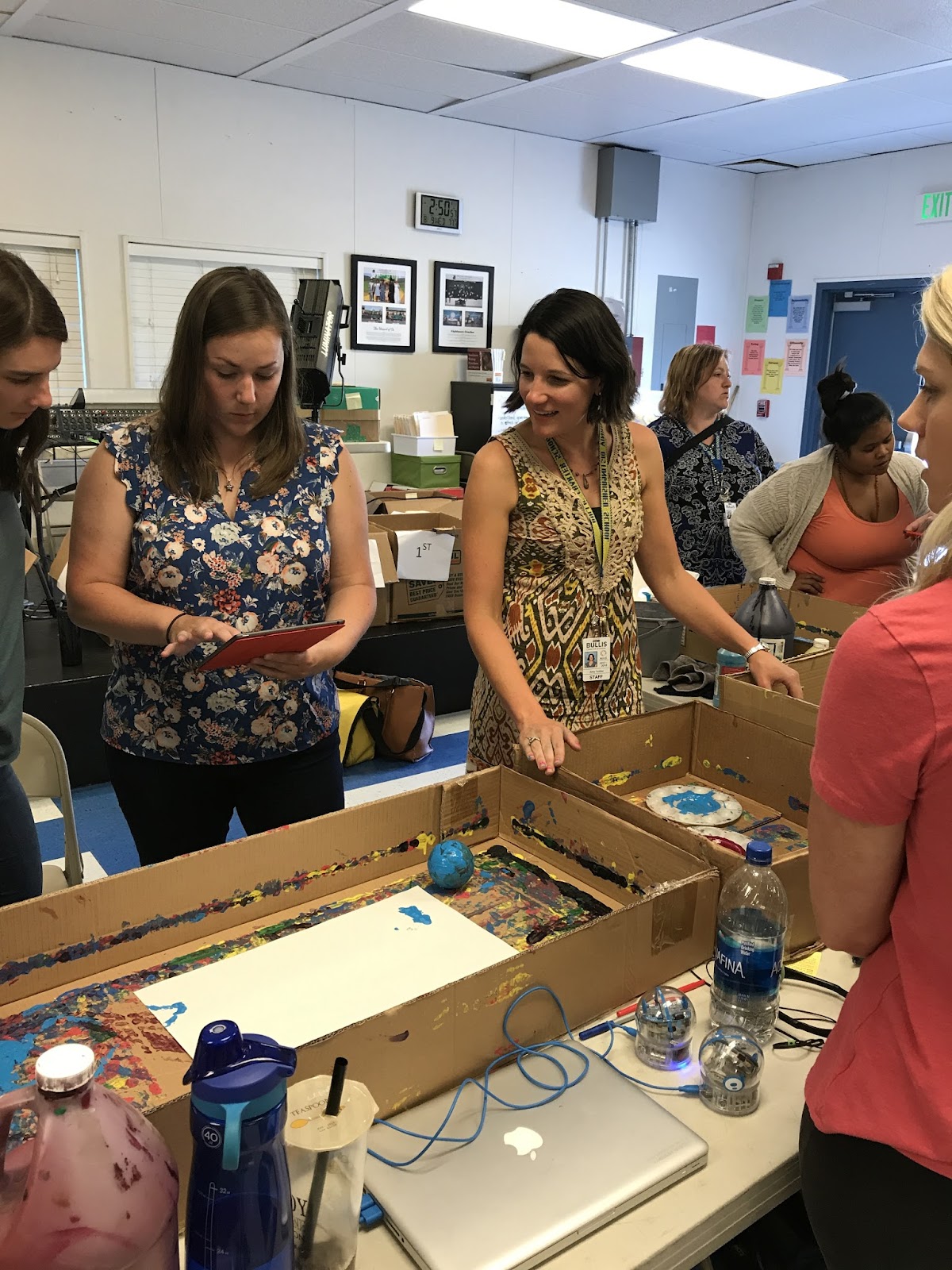
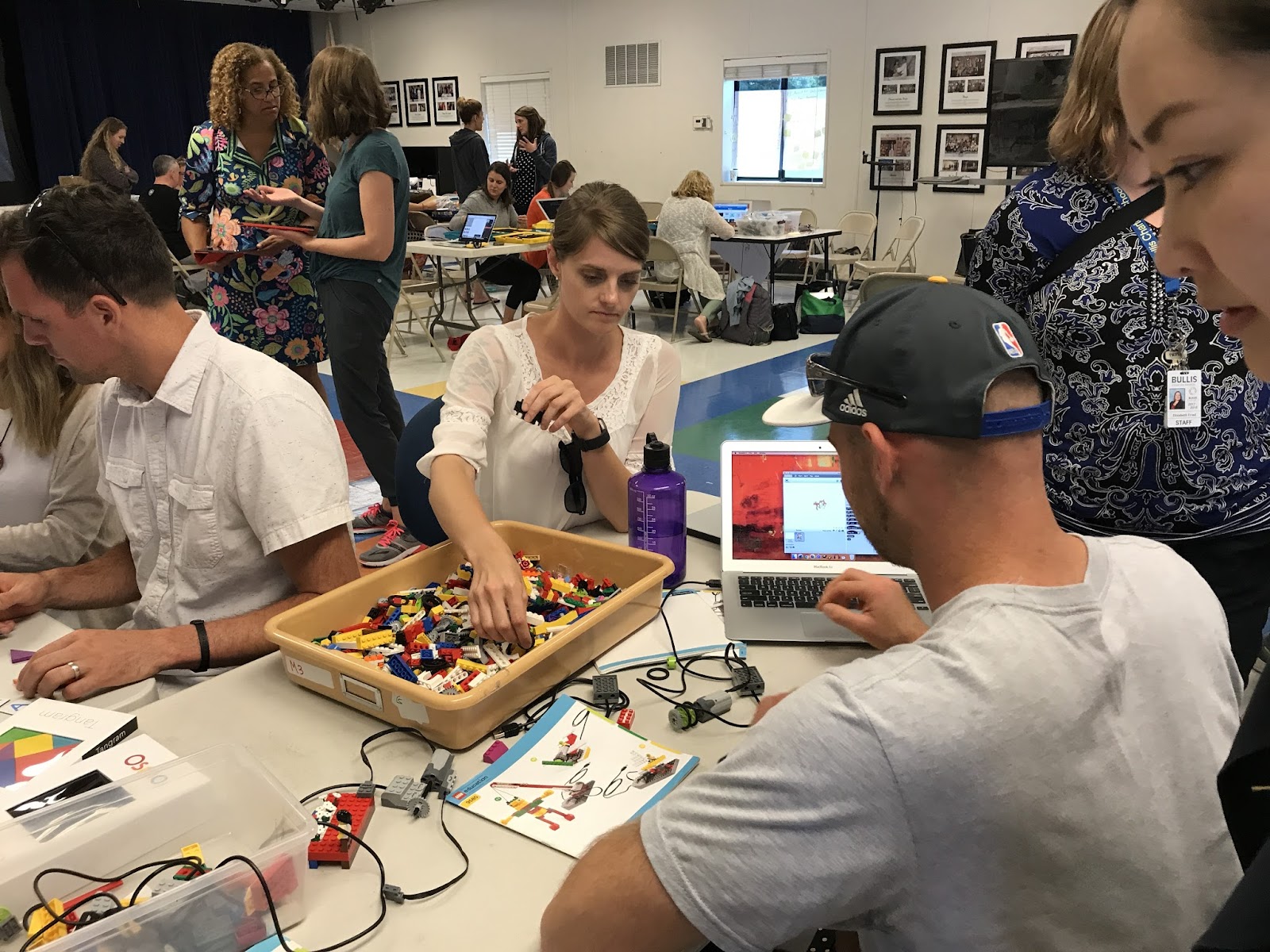
Another particularly engaging event was the ‘Tech Tools’ learning challenge. BCS’s Art, Math, MakerSpace, and FabLab specialists led the staff through activities they use with students that integrate technology into the curriculum. A few favorites were:

  • Sphero – Painted artwork created using an iPad and an app-enabled ball
  • littleBits – Circuitry kit used to build something that lights up
  • Makey Makey – Invention kit that turns everyday objects into touchpads, used to build electronic pianos
  • Osmo – Game system that enables an iPad to see what's in front of it, allowing students (and teachers) to receive feedback as they use blocks and colored tiles to create patterns, tangrams, etc.
Although this was BCS founding and current middle school teacher Lisa Stone’s 14th year of participation, she still finds opportunities for growth and reflection in BCS’s staff development program. "Innovative approaches to education and the tools employed to implement them are constantly being developed, so each year I learn so much despite being a veteran teacher. Not only do we learn about these innovative approaches, but we also have time to discuss with our colleagues how to implement them, moving together as an entire staff to make the BCS student experience better with each passing year."

Friday, April 28, 2017

A Teacher's View of "Skills For Today"

April 24th - 28th is P21’s "Skills for Today" Week, sponsored by the Partnership for 21st Century Learning (P21).  The celebratory week was designed to showcase how the P21 Framework for 21st Century Learning and the 4Cs — Communication, Collaboration, Critical Thinking, & Creativity — can empower all learners to gain the skills they need for success.

“If we want to set our children up for success in college, career, and life, opportunities to learn 21st century skills are essential,” says David Ross, CEO of P21. “The "Skills for Today" week will not only help shine a national spotlight on the importance of these skills for our students but also highlight the critical elements of a successful education in the 21st century and the resources, research, and best practices that bring these skills to the classroom.”

Bullis Charter School is one of 79 schools and school districts nationwide to be named a P21 Exemplar School. All BCS students are given numerous opportunities to develop the 4Cs and acquire the 21st Century skills they need to thrive in a world where change is constant and learning never stops.

In honor of P21’s “Skills For Today” week, BCS 5th grade teacher Jessica Morgan shared the following observations of her students exhibiting the 4Cs in the classroom, as well as her belief in the value of 21st Century skills for all students:

I had a moment this week that emphasized how much I love the creativity and drive in our students. I was doing one circle of the classroom toward the end of an assessment period in order to check how many students were still working on the test and to monitor the choices students were making if they finished early. In that one period, I saw:
  • one student silently rehearsing percussion patterns for the “BCS Fight Song” and some other music he had to memorize for band
  • one student studying lines for an upcoming musical performance
  • two students practicing drawing for personal FLGs
  • one student crafting an email to a parent to take responsibility for something that happened that day
  • one student working on a Math exemplar to practice critical thinking and multi-step problem solving before tomorrow’s test
  • one student writing up Spanish notes for practice

All of these students were completing these tasks without any prompting from me. They were thinking carefully about what they needed to do as individuals to keep making progress, and they took steps to make it happen. This is a priceless skill that will inevitably help them in all areas of life!

-- Jessica Morgan (@jessreedmorgan), April 26, 2017

Wednesday, June 8, 2016

English Language Arts

Like our math program, English Language Arts (ELA) instruction at BCS goes well beyond reading a story, answering multiple-choice questions, or writing a few summary sentences. Instead, the ELA program is carefully designed to encourage students to develop as critical thinkers and strong readers and writers, while meeting the needs of all of the school’s diverse learners with a variety of proven teaching practices.

In kindergarten, a lesson may begin with a quick review of short and long vowel sounds followed by small group “reading centers,” where students work with teachers on their reading skills and reading comprehension. The teacher stops every few pages to ask, “What have we learned so far in the story?” or “Which describing words were just used?” Recently, a kindergarten ELA lesson included a comparison of writing styles and a discussion of how a writer can use words to convey feelings, tell a story, or even teach a new subject. Science was then integrated into the lesson when students were asked to “teach” by writing true facts about a science topic they just studied.

In second grade, the teacher may incorporate the Common Core State Standard, “compare and contrast two or more versions of the same story by authors or from different cultures,” by reading to the students the classic version of Goldilocks and the Three Bears and the Chinese rendition, Goldy Luck and the Three Pandas. While listening to the two stories, students take notes on the similarities and differences. Using their notes, the students create a Venn diagram (an illustration of the relationships between and among sets or groups of objects that share something in common) and work with a partner to develop a storyline for their own version of the Goldilocks story.

In fourth grade, students study a new historical fiction novel every three weeks in small group book clubs. Time is reserved for students to independently read their assigned books, but they must take notes on the characters, settings, and themes in preparation for their book club discussions. The book clubs are designed to help students think more deeply about the text and to make real-life connections about what they are reading.

Part of the fourth grade Common Core State Standards is to learn about multiple perspectives, and BCS combines fourth grade California history curriculum with language arts to meet this standard in an integrated and comprehensive way. As students study the Transcontinental Railroad or the Mission Period in California, they are tasked with role-playing various characters to help them understand the multitude of perspectives of people who lived in these time periods. They are also taught the correct procedures for conducting online research, including differentiating between authoritative and non-authoritative sources as well as identifying primary sources. Through this research, they begin to understand how historical events impacted people differently, and they learn that the winners are most often those who write history. This is why, as readers, they have to be mindful and think about the different sides of every story. These lessons are not about memorizing and regurgitating historical information but rather about how to understand history and literature in context from multiple perspectives and how to write an essay that thoughtfully and accurately conveys these multiple perspectives.

In fifth grade, students continue to analyze literature by creating empathy maps where they interpret how a character’s speech or action provides insight into how the character is thinking or feeling. Through these maps, they demonstrate how the characters evolve throughout a story, and they learn to employ language using phrases like “it was a metaphor for…” Students also develop their ability to concisely summarize a story by using sentences that begin with “In the beginning….,” “In the middle….,” and “In the end….” They also learn to end their literary summaries with a concluding sentence that reflects on the story and its theme.

Fifth grade students also learn how to create arguments.  An example of one of their prompts is “Should chocolate milk be served in school?” To help students develop their arguments, the teacher distributes several nutrition articles about chocolate milk. Students then create flash drafts of their argument and work with the teacher to develop plans to find more evidence for their opinion or to find an additional reason to support their claim. The teacher discusses the importance of textual evidence and tasks the students with using articles to find textual evidence to support their claims. Students discover the importance of quoting sources from their research and paraphrasing if a quote is too long.

The English Language Arts program at BCS is designed to support the school’s mission of educating the whole child. Through ELA instruction, we hope to develop students who are critical and analytic thinkers, who can examine the meaning of a text beyond the surface of its words, who can see and empathize with different points of view, who can support their opinions and arguments with evidence, and most importantly, who will develop a lifelong love of learning.


Wednesday, May 25, 2016

Math Instruction at BCS

With the shift to Common Core State Standards in Mathematics (CCSSM), the benchmark for math mastery is no longer about simply producing a “correct” answer. Gone are the days where students are asked to fill in endless worksheets to show excellence in mathematics. Timed multiplication tests are no longer the barometer for high achievement. So one might wonder: What is this “new” math that our children are tasked to learn?

The CCSSM is not “new” by any means but rather, developed to raise the level of rigor in previous math standards to ensure that the math learning at one level builds and supports the levels above it. Still, it is not enough to have standards by which to measure our growth and understanding. As parents and educators work together to support student learning, our own beliefs about mathematics and math instruction must shift as well. Math is no longer about simply using a formula; it is about understanding how to derive a formula and then determining its usefulness. Math is no longer about the teacher talking and the student listening; it is about being an active participant while collaborating and communicating ideas. Math is no longer about predictable worksheets; it is about authentic experiences with real-time constraints. Math is no longer self-contained; it is about integration. Math is no longer about skimming the surface; it is about stretching and deepening our knowledge. So one might wonder: How do we get there?


Much like an open-ended problem, there is not just one “right” path. At BCS, math instruction is carefully designed to look and be different because we believe in meeting the needs of all our diverse learners with a variety of proven teaching practices. In first grade, a lesson begins with a short introduction to the big math idea for the day. From there, students rotate to “centers” such as “math with someone” for a joint activity, “math by myself” for independent practice, “math with the teacher” for differentiated work and “math with technology” for integrated skills practice. This style of instruction engages children in ways that allow for student choice while developing independence and autonomy all while having ample time to practice 21st century skills such as teamwork and responsibility.

In a fourth grade lesson it opens with a question: “What are the defining attributes of a triangle?” The class is silent as everyone engages in private think time. Moments later, as the teacher facilitates, discussions erupt from all corners of the classroom and a dozen ideas fill the air. Quickly, the lesson transitions to a whole group discussion led by students’ ideas. Hands shoot up immediately as children volunteer to share what they know, as well as some misconceptions moderated by the teacher. A short video follows and again, children are engaged in a discussion  and encouraged to talk about the mathematics using “I notice…” and “I wonder…” statements. A team task follows and high engagement and energy returns. The lesson, driven by student voices, builds upon students’ prior knowledge while subtly introducing new ones.

In a fifth grade class, the teacher poses a situation: “I need to paint 4 walls of a room. Each wall requires one-third of a gallon of paint. Every wall needs to be painted evenly but I am unsure how much paint to buy and I don’t like to overbuy. Find solutions to my problem. Be prepared to present your case with a written proposal supported with visual models as evidence. BEGIN!” Children quickly break up into teams of their choosing and begin sharing ideas. Across the room you can hear students saying, “I’m not quite sure how that would work but it’s worth trying.” and “What if we…?” and “Wait, how come…?” Work of every caliber is strewn across tables and in every child’s hand is a math tool of their choice: a ruler, colored pencils, unit blocks, whiteboards, etc. A flurry of activity takes over the room as children are challenged to push their understanding of fractions beyond the standard algorithm by defending their work through the use of visuals, models and alternative solutions.

At BCS, teachers understand the importance of integration with other subject areas through the use of Project-Based Learning (PBL) units. This style of learning and teaching is not for the faint of heart but if you are looking for excitement, engagement and challenge in math - this is it! Through PBL, students become adept at applying math in all situations at all times. In second grade, students are tasked to to design a new state based on their math and social studies units. Teams work together to use geometric nets to erect city buildings and businesses. They use map skills learned in social studies to create the infrastructure for roads and highways by thinking about parallel, intersecting, and perpendicular lines. All the while, students have to ensure that their work is meeting the needs of the driving question.

The math program at BCS is tethered to our mission of developing the whole child and along with CCSSM, we are raising the bar for children of all abilities to feel successful not just in math, but well beyond college and career readiness. Our approach may not look like what math looked like 20 years ago but that is OK since our commitment is about preparing children for successful futures, not the past. 

Wednesday, May 18, 2016

Leveraging Silicon Valley Innovation in the Classroom

BCS recently partnered with Cisco to create a unique, experiential learning opportunity for our 6th - 8th grade students. The first-ever "Innovate Together" Hackathon provided our middle school students with the opportunity to work with some of the valley's leading programmers, engineers and entrepreneurs, and will serve as a model for Cisco's future work with other schools.

Learning@Cisco's
VP and General Manager, Jeanne Beliveau Dunn, describes the collaboration in her blog: Invest in Experiential Learning to Create a Digital Ready Workforce


Thursday, May 12, 2016

Cultivating Creativity Through Choice

At Bullis Charter School, creativity and curiosity are considered vital 21st Century skills. To help students unlock and pursue their individual dreams and passions, we offer a rich array of co- and extra- curricular classes. These ‘choice’ activities allow students to explore their own talents and interests and help to develop the whole child. Co-curriculars are held once per week during the regular school day. Each child participates in two co-curricular activities per semester and every BCS teacher is required to develop and lead two of these activities. This year, students were offered an incredible array of co-curricular courses, including picture book writing, advanced Lego robotics, ceramics, public speaking in Mandarin, and web design. Extra-curriculars are also taught by BCS’s homeroom and specialist teachers and are available to every student, but they are optional, after school activities. Extra-curriculars include everything from sports, color guard, and dance lessons to math games, chess club, and fine art classes.

A brand new co-curricular offered to BCS first and second grade students this year is called “Engineering Design with Wood Blocks.” First grade teacher Mrs. Ly created this activity and begins the class each week by telling a story about a harmonious town in a far away land called Peace Town. Everyone in this town lives together in harmony and everyone helps each other out.  However, to integrate engineering design into this activity, the story always ends with a problem that the students need to solve for the people of Peace Town. This type of problem solving develops the students’ design thinking skills. It also helps them to build empathy since they need to emphasize with the people of Peace Town and to understand the problem before they can begin to devise solutions. For example, when challenged to create ways to let visitors into the town, the students created a musical buzzer that when rung, makes beautiful music. As the children explained, “the people of Peace Town are peaceful people and want to hear beautiful and peaceful sounds.”

In Mrs. Ly’s classroom there is a dedicated “Construction Zone” where students use wooden blocks to build their solution prototypes. Although they can choose to work collaboratively or alone, once one or two students begin to construct something other kids often join in, sharing their ideas and expertise. Some of the students ask if there are more blocks they can use or other materials they can add to their creations, but just like engineers in the real world, they are instructed to create their design using the supplies on hand. The students must talk through their ideas, collaborate with their partners or teams, and include lots of detail in their planning. Using this active learning model, these young students have built some amazing structures. Their creations remain unaffected inside the construction zone throughout the week and every Friday the students clean up the area and start all over again on a new structure. The students also write in
their journals about what they have built and why, and they can refer to pictures Ms. Ly has taken during their building session to help remind them of what they built. This encourages them to include lots details in their writing and reflections.

The students have developed a real passion for their design and building co-curricular and it is obvious that they are having a great time working with friends, collaborating, and problem solving. After the first session, students asked Mrs. Ly if they could stay after school and keep building. One student even asked if it would be possible to stay and build if his mom came in to supervise. Clearly, these young engineers are just getting started!

Wednesday, May 4, 2016

BCS Mandarin Program

BCS’s World Language program, available to all students K-8, was designed to support the school’s mission to graduate students who are confident, global citizens.  Mandarin and Spanish instruction are offered to students several times per week and much of the core content, traditionally taught in English, is integrated and reinforced in these language classes. 

BCS educators researched the benefits of many world languages before deciding to offer Mandarin instruction at the elementary level. Almost 900 million people worldwide speak Mandarin, making it a prominent language in both eastern and western cultures.  Research shows that children benefit from learning a tonal language like Mandarin at an early age, as it helps develop musical ability and pitch.  In addition, learning a non-alphabetic language activates different parts of the brain as young learners process the characters and develop visual-spatial analysis.

At BCS, all Mandarin teachers are native speakers and bring with them a deep knowledge of the language and culture.  By utilizing technology such as podcasts and on-line collaboration tools, the Mandarin team is able to provide differentiated instruction for all students, whether they are beginners or native speakers and whether they enter the program at kindergarten or middle school.

Public speaking is an important feature of the BCS Mandarin program. Students are required to present to their class at the end of every learning unit, reinforcing their learning and providing numerous opportunities to practice speaking Mandarin. The students’ regular homeroom teachers say that these presentations really help the students improve their public speaking skills, and build their self-esteem and confidence. Please enjoy some of these Mandarin presentations below!

Kindergarten students share the names of shapes:
https://www.youtube.com/watch?v=xQtbxH33zpk

Second grade students role-play how to buy and sell fruits.
https://www.youtube.com/watch?v=l7U7qOSzsXA

Fourth grade students produce a Chinese shadow show, which supports their study of zoo habitats.
https://www.youtube.com/watch?v=n7tZaUSymNM&feature=youtu.be

Fifth graders role-play ordering food in a Chinese restaurant. The students developed their own scripts and printed them in Chinese characters.
https://www.youtube.com/watch?v=GRMSwju4OTM

Wednesday, April 27, 2016

Kindergarten Students Learn about Community Helpers

BCS kindergarten students recently learned about community helpers as part of their social studies curriculum.

Kinder classes learned how police officers keep citizens safe by making sure everyone follows the law. The students explored the different tools police officers use in their work, drew pictures of the officers with these special tools, and wrote short pieces about police work.  In addition, students became familiar with important signs such as: “BIKE XING” and “POISON”.

The students were most excited to make police badges and hats and to attend “Kindergarten Police Academy,” where they had special police work to do - fingerprinting! As they took their own fingerprints, they practiced the names of each finger and learned that each fingerprint is unique. They also learned a fun trick to help them
remember which hand is their left and which is their right.


On a field trip to the Los Altos Fire Station, students met local firefighters, learned how they help the community, toured their living quarters, and, best of all, sat in a fire truck!  The kindergartners loved watching their teacher, Ms. Lunsford, try on 90 lbs. of firefighter gear and try to swing an ax while wearing this heavy uniform. Upon returning from the trip the students wrote letters to the firefighters, sharing their favorite part of the visit and thanking them for allowing the class to visit.


Dr. Manche, ophthalmologist and kinder dad, came to class to talk to the students about being a doctor. Dr. Manche shared a model of an eye and let students try on special 3-D glasses and look at pictures. He talked about why he wears special gear to perform surgery, and provided hair nets, masks, and goggles for the entire class.  Much to their delight, Dr. Manche also presented every student with a bouncy eyeball! The students loved having Dr. Manche as a special visitor.


Thursday, April 21, 2016

The Dramatic Benefits of the BCS Drama Program


As a S.T.E.A.M (Science, Technology, Engineering, Arts, and Mathematics) school, BCS offers music, art, and drama instruction as part of the core curriculum. During weekly drama class, students learn to perform scenes, monologues, and songs from well-known plays and musicals, engage in improvisation, and learn about the technical side of theater including stage direction, scene and costume design, and light and sound engineering. Throughout the year, large-scale drama productions provide students the opportunity to put these skills to use.  This school year includes productions of Haphazardly Ever After (Grades 1-4), The Aliens are Coming (Grades 4-5), Guys and Dolls (Grades 6-8), The Lion King Jr. (Grade K-4), Into the Woods (Grade 5), and A Mid-Summer’s Night Dream (7th Grade).

BCS is fortunate to have on staff two amazing, full-time drama specialists who engage students in this wonderfully creative aspect of the school’s art program. Jocelyn Pickett works with BCS K-4 students and Jeff Clark works with BCS 5-8 grade students. I had the opportunity to talk with both specialists during afterschool rehearsals for The Lion King Jr. and Into the Woods and here is what they had to say about the importance of incorporating a drama program into the core curriculum of any school.

Why is it important to expose all students to drama?


Mr. Clark: It is important to expose students to drama, even those kids who have no desire to perform on stage, because it builds a myriad of skills they may need for future endeavors. Drama provides the students with experience presenting in front of large groups, it teaches them the art of voice projection, and it develops their ability to think quickly on their feet when in a situation in which they need to improvise. Participating in drama also opens the students up socially, requiring them to work with other kids who they may not have chosen to spend time with in a social situation. As part of their assignment, they must create a performance project with this partner—listening to and being heard by the partner. This helps the students develop the ability to listen to the ideas of others and it also provides them a safe place to try out their own creative ideas.

Ms. Pickett: Teaching drama is important because it teaches something that is not often incorporated into a standard school day. Math and science are logical. Life isn’t like that though, and neither is drama. In performance, there is no right or wrong answer. Drama is an opportunity for open creativity and it provides a chance to build creative confidence. It is Ok to make mistakes in drama and in fact, mistakes are wonderful because they may lead to the creation of something beautiful. Mistakes also allow the performer to rebound and improvise. This is an opportunity for pure creation and innovation. The only mistake one can make in drama is to not try or participate.

Another amazing aspect of drama is it teaches one not to be selfish. You quickly learn that the person next to you on the stage is important. This teaches the students to pay attention to the other actors.

What are some of the additional skills students learn in drama class and what are the added benefits of incorporating a drama program into a school curriculum?

Ms. Pickett: As a drama specialist I get to see the actual child; they don’t put on façade in drama class. In drama, students can show how they are really feeling that day and use that emotion as part of their performance. This is true social, emotional learning (SEL). Drama also teaches the students how to deal with disappointment. Not everyone can land the role of Snow White and that is Ok, because Tree #2 is just as important as Snow White in the production. A performance is not about the individual on stage but rather about how to convey a message to an audience. To do this, you need everyone to work together as a group. It is not about one person being a star but rather about creating a piece together as an ensemble. Drama is the ultimate team sport and there are lots of group problem solving skills involved in pulling off a successful production.

How do you choose what the students will act out in drama class?

Mr. Clarke: Currently, the 5th graders are working in class on scenes from the musical 1776. They 1776 was chosen because it aligns with the 5th grader’s core curriculum in history, which focuses on Colonial American and the Revolutionary War. When choosing an afterschool production, it is often all about how to manage the logistics. For example, I need to consider how many students want to participate and then choose a play or musical that has enough parts for all who want to join. After meeting this benchmark, I decide what kind of production would be good to expose the students to. A few years ago we performed Oklahoma, which is an iconic musical because when it was first produced in the 1940s and 1950s, it changed the way all future musicals were created. This musical has real historical relevance and as part of preparing for the production, the students discussed the history of the musical and learned about the time period in which it is set. For every production the students produce, it is important for them to really understand its background and to immerse themselves in its history.

Upcoming BCS Performances:
Performances of Into the Woods will be held on April 28th and 29th at 7:00 pm and on April 30th at 2:00 pm. Performances of Lion King Jr. with the north campus cast will take place on May 5th, 6th and 7th at 7:00 pm, with an additional 2:00 pm production on May 7th. Performances with the south campus cast will take place on May 12th, 13th, and 14th at 7:00 pm with an additional 2:00 pm production on May 14th. Performances of A Mid-Summer’s Night Dream will take place on June 6th and 7th at 7:00 pm.


Wednesday, April 6, 2016

5th Grade PBL: An American Revolution Museum

BCS 5th graders recently completed a Project Based Learning unit (PBL) where they were tasked with designing a museum experience about the American Revolution. The PBL’s driving question was: “How can we, as artists, create a museum experience that connects our community with the people of the American Revolution?”

When designing the driving question, the fifth grade teachers purposefully included the word “people” to encourage the students to get into the mindset of the people of the American Revolution. By considering those who initiated and fought in the war, the students are better able to develop empathy for their experience and understand the society in which they lived.


Utilizing the design thinking process, the fifth graders interviewed students in other grades to hear different perspectives on what makes a fun and educational museum experience. Based on the feedback they received, each student brainstormed ideas on how to present the American Revolutionary War in a museum setting. Students then chose one idea to focus on and built a prototype of their idea. When finished, they presented their prototype to classmates and received feedback on their design.

Some students struggled with not knowing what their end product would look like. “Students often start the process with ‘is it OK if…,’” says fifth grade teacher Jessica Morgan. “I always respond to this inquiry with, ‘I don’t know, what do you think?’ I want the students to own their design process. I encourage them to refer to the driving question if they feel unsure about their ideas. In the end, there are no wrong choices or presentations. As long as the student answered the driving question, they have succeeded. The way in which each student does this will be different and that is part of what makes the end results so exciting.”

Specialist teachers worked closely with the students on this PBL, helping the students to integrate art, drama, and music into their exhibits. In art, students examined political messages from the time period and developed their own political cartoons to encourage or discourage someone from participating in the Revolution. In drama, students practiced speaking from different perspectives to understand how to portray a person from the Revolution. In music, they composed original pieces of music reflecting the musical style of the time period. 


The students were free to choose how they wanted to present their final displays as long as they were historically accurate and connected the museum audience to someone from the Revolution. Some students made paintings about the Revolution, some wrote memoirs using the perspective of someone from the time period, and others created scratch games or board games to explain specific events in the war. A few students even integrated their drama skills and produced a skit about the people of the Revolution.

The museum opening was a well-attended event bustling with parents, staff, and students. “The variety of displays the students created are impressive. It is amazing to see what fifth grade students are capable of accomplishing,” said fifth grade teacher Mr. Villaluz. “These exhibits are the culmination of everything the students have learned about project-based learning at Bullis and this incredible event is the result of what happens when you give students a say in their learning process.”


Wednesday, March 30, 2016

Using Art to Teach Social Emotional Learning at BCS

According to the Collaborative for Academic, Social, and Emotional Learning (CASEL), Social and Emotional Learning (SEL) “is the process through which children and adults acquire and effectively apply the knowledge, attitudes, and skills necessary to understand and manage emotions, set and achieve positive goals, feel and show empathy for others, establish and maintain positive relationships, and make responsible decisions.”

Studies have found that developing social and emotional skills at an early age fosters teamwork and problem-solving abilities, helping students grow into good students, citizens, and workers. SEL also lowers stress-levels and reduces certain risky behaviors, including bullying and drug use. Bullis Charter School stays current with these findings and believes strongly in helping its students develop the social and emotional skills necessary to thrive at all stages of life. For this reason, BCS integrates SEL into every aspect of its program, from the six pillars to classroom instruction.

BCS art specialist Amy Felder integrates social and emotional learning lessons into her curriculum throughout the year. She engages her students in creative SEL art lessons including Super Self-portraits where students create drawings of themselves as superheroes who possess one imagined superpower that will help them overcome a fear. First graders study the stars and the moon and create their own version of Vincent van Gogh’s Starry Night. As part of the lesson, they read about Van Gogh and discuss his life struggles. The students practice empathy and imagine what it would be like to be Van Gogh. When learning about how certain townspeople mistreated Van Gogh, they discuss the importance of being caring and respectful towards others and how not doing so can leave someone feeling sad and lonely, like Van Gogh.

Recently, Ms. Felder invited artist Barbara Tolloczko, grandmother of a BCS kindergarten student, to talk to the class about how they can express their feelings through art. Mrs. Tolloczko showed the students a slideshow, explained how she gets her ideas for her own artwork and shared the different mediums she uses for her art. The simplest way to express herself, she explained, “is to draw something with a pencil on paper.”  She next showed the students various ways to add color to the drawing by using watercolors, colored pencils, markers, crayons, or pastels. When the slide of an oil painting depicting a dancing lady appeared, she asked the students, “What did I do to make it look like the woman is dancing?” The students examined the figure before them. The posture of dancer’s head was tilted back, her arms were behind her, she was standing on one leg, and her dress was floating in the air; all signifying she wasn’t standing but dancing.

Next, she discussed with the students how she decides what to draw. Of course, the easiest way is to draw or paint what you see. Sometimes though, it is fun to draw or paint what you imagine. After sharing slides of mythical animals, Ms. Tolloczko asked,  “Did you know that it is also possible to paint your idea or opinion about something? For example you can use snakes to represent someone’s hair if you want to depict them as not a nice person.”

Most importantly, art can be used to express your feelings and this can be done in ways other than drawing a happy or sad face. Ms. Tolloczko showed the students a painting of a lady with an octopus on her back and asked them what they thought this could mean? Perhaps the woman is trying to escape something but can’t. Maybe she feels overwhelmed or is carrying a heavy burden. She then showed the students a slide of a woman dancing and swirling in a bright happy dress. “How do you think she feels?” Mrs. Tolloczko asked the students? “Happy,” they responded in unison. “But, did you know you do not always need to put a person in your picture to show if you are feeling happy or sad. The colors you use can also represent your feelings.”

Armed with their new artistic knowledge, Ms. Felder gave the kindergarten students time to create their own artwork representing how they feel. She instructed them not to share the feeling they were drawing. When finished, she invited them to present their drawings and let their classmates guess the feeling depicted. By the end of the lesson, these young students had all discovered a new way to express their feelings through art. Developing this awareness of their emotions is the first step in learning to dealing with feelings in a healthy way, which then allows the students to control their actions. Instead of acting out from fear or anger, students can empathize with what another is feeling or experiencing and respond accordingly with care and kindness.


Thursday, March 24, 2016

Leatherback Sea Turtles: An Essay by BCS 2nd Grader Nathan Becker

As part of a project-based learning unit focused on the threats faced by Leatherback Sea Turtles, second graders used the design-thinking process to develop innovative solutions for keeping the turtles safe. Students presented their creative prototypes to peers and parents, and Ms. Tomasetti's student, Nathan Becker, shared this well-written and thoroughly researched essay about what he had learned. 

The Leatherback turtle has survived for more than one hundred million years, but it is now facing extinction. The leatherback’s scientific name is dermochelys coriacea. That means wide-ranging marine turtle with flexible leathery carapace.

The global population for this species was estimated to be 115,000 adult females in 1982. By 1996, this had been revised down to about 30-40,000 Leatherback populations in the Pacific and Indian Oceans have dropped a lot in the past forty years. For example, the nesting colony in Terengganu, Malaysia went from more than 3,000 females in 1968, to 20 in 1993, to 2 later in 1993. There are no signs of recovery. 

Leatherbacks have been recorded as far north as Alaska, and as far south as Africa’s Cape of Good Hope. The Pacific Ocean may now have as few as 2,300 adult females.

However, not all Leatherback populations have declined. In southern Africa, three decades of strong protection have increased the small annual nesting populations more than four times.

Leatherbacks have survived for a long time but they are dying out and soon they may become extinct. In the Pacific and Indian Ocean, the Leatherbacks populations are getting smaller and smaller. But, not all Leatherback populations are shrinking. In some places people are protecting them.


Wednesday, March 16, 2016

BCS Middle School 8th Grade “Design Challenge” Intersession

Imagine an environmentally sustainable school that includes a roof top garden where crops are harvested for school lunch, a grey water system to flush toilets, and solar panels that harness the sun’s energy for electricity. Picture buildings with expansive windows that invite in an abundance of natural light, moveable walls to create multi-purpose educational spaces, interactive furniture that encourages high energy students to focus, and ramps leading to every classroom to accommodate students and staff with disabilities.

You would expect this utopian learning environment to be the work of an experienced architectural design firm, but these are the innovative features Bullis Charter School eighth graders incorporated into their school designs during their recently completed “Design Challenge” Intersession. For three weeks,
students worked in small groups to develop comprehensive “School of the Future” designs. They were instructed to use green design elements, to incorporate educational philosophy, and to leverage community connections. Students interviewed various
experts in the fields of architecture, interior design, and education, and visited a zero-waste home in Palo Alto. Upon the completion of the Intersession, these same experts sat on a panel to hear the students’ presentations, look over their models, provide constructive feedback, and select the most innovative school design. The winning group will submit their digital designs, laser-cut models, presentations, and essays about their design to a competition called SchoolsNEXT, run by the Association for Learning Environments. Last year, the winning BCS team advanced all the way to the final round of this international competition.


"Eighth graders are at an age when they are forming strong opinions about how society should function," says eighth grade teacher Rebecca Witmer. "Creating the ideal school engages them because they enjoy critically examining school, breaking down institutions as they currently know them, and designing a place where they want to spend their time."


This year, the students were tasked with the special focus to create a campus that would meet the needs of underserved students, who make up one in five children in our larger community. The students mapped out areas of poverty in the Bay Area and studied struggling school districts. Students discovered that not everyone learns in the same way and that some students have different needs, whether physical or mental. Empathy-building is a critical element in the design thinking process, and conducting this research opened the students’ eyes to different learning styles as well as to the experiences of others.

The Design Challenge Intersession supports the development of 21st century skills, including critical thinking, creativity, time management and perseverance. Students are challenged to work collaboratively in groups and produce concrete results in a short time frame. When they
enter the classroom or the Fablab, they know what they need to do and on which aspect of their project they need to focus. The students conquered a variety of real world challenges, such as technical difficulties, and yet every group met the tight deadline. BCS eighth grader, Kat, learned something powerful about her own capabilities, “It really is possible to get this done in three weeks and it was amazing to see it all come together in the end.”